As developers, we use Power Automate to handle everyday tasks and automate small parts of our work. Flows help reduce manual effort, improve accuracy, and make repeated tasks run smoothly. But just like many of us experience, we often face one big challenge, i.e., writing expressions. Expressions may look small, but they require time and attention. A single missing bracket, a wrong variable name, or an incorrect function can break the entire flow. Even small mistakes lead to errors, and we end up spending more time fixing the expression than building the flow itself.
As flows become more complex, updating these expressions gets even harder. Keeping track of brackets, functions, and formatting becomes challenging, and even a simple update starts to feel like a task of its own. It can be frustrating for anyone working on it.
While looking for something that could simplify this process, we came across a feature that genuinely helped eliminate most of these issues is Copilot Expression Assistant.
This feature lets you create expressions using natural language. Instead of manually writing long formulas, you simply describe what you want in plain English.
Why Copilot Expression Assistant Matters
Power Automate expressions are powerful, but they come with challenges:
- They require precision, and syntax errors break flows.
- Updating or modifying nested conditions is tedious.
- Complex formulas take long to write and even longer to debug.
The Copilot Expression Assistant solves these problems by generating expressions automatically, eliminating guesswork and reducing manual time spent writing and fixing formulas.
To understand this new assistant feature, let us take a scenario where we want to build a complex expression, which would take me an hour or so, however, using the Copilot Expression Assistant, I can pass a prompt explaining the copilot what and how I want my expression, and in no time it would give me the expression. Below is how the copilot gave me the expression –
We wanted to make an expression where we would send an email to our team lead which could show when a new lead is created. It could show the lead’s name, email, created-on date and time, and automatically categorize the quality of lead based on its revenue.
Use Case: Building a Complex Expression in Minutes
Let’s consider a realistic scenario. We needed an expression for a flow that sends an email to a team lead whenever a new lead is created. The email must include:
- Lead Full Name
- Email (or “No Email” if blank)
- Created-on date in Indian time zone
- Lead quality category based on revenue:
For example:
- If the revenue is more than 75,000, it should say Flagship Lead
- If it’s more than 50,000, it should say Premium Lead
- If it’s more than 25,000, it should say High-Value Lead
- Otherwise, it should show Standard Lead
And each detail should appear on a new line with proper labels.
Manually writing this expression would require:
- A long concat() expression
- Null handling with coalesce()
- Date conversion functions
- Multiple nested if() conditions
- Proper line breaks using <br>
- Careful handling of quotes, commas, and brackets
This could easily take an hour, and still be error-prone.
How We Built It with Copilot
To create this expression, we didn’t write any formulas manually. We simply opened the Copilot Expression Assistant and typed a short prompt describing exactly what we wanted. Something like:
“Create an expression that combines lead first+last name, shows email or ‘No Email’ if blank, fetch created-on with “Indian timezone”, set quality of lead by revenue (>75000 Flagship lead, >50000 Premium lead, >25000 High-Value lead, else Standard lead). Use <br> for new lines. give proper labels.”
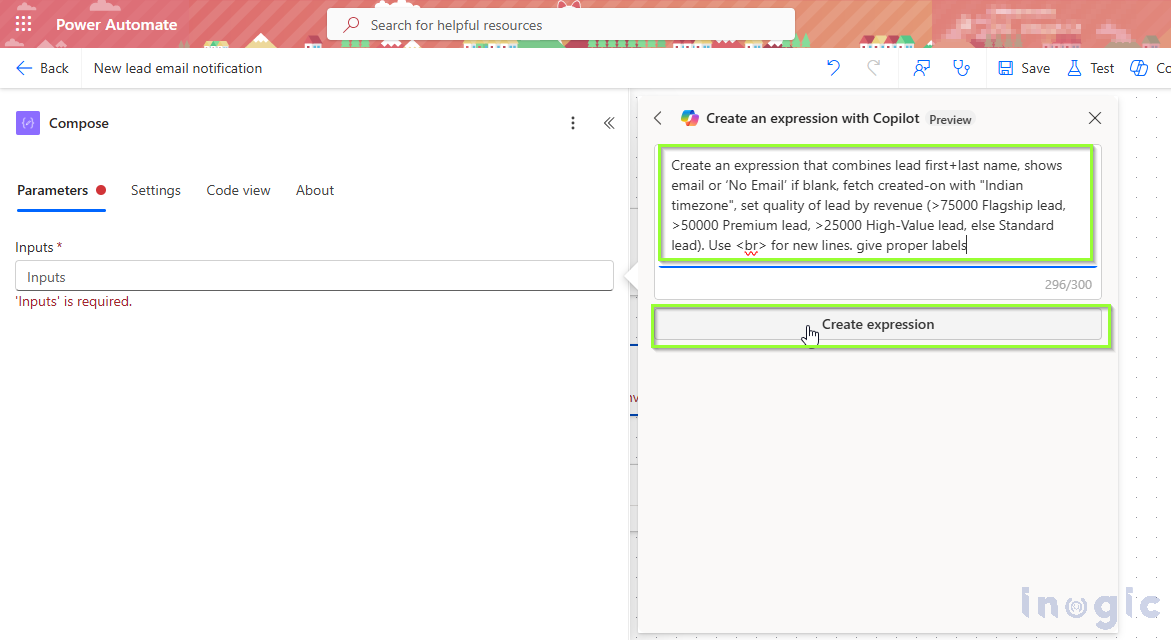
Copilot understood the requirement and instantly generated the complete expression for us – with the correct functions, conditions, and formatting. We didn’t have to worry about syntax, brackets, or nested logic. Just one simple prompt was enough to get the whole expression ready...Read More>>